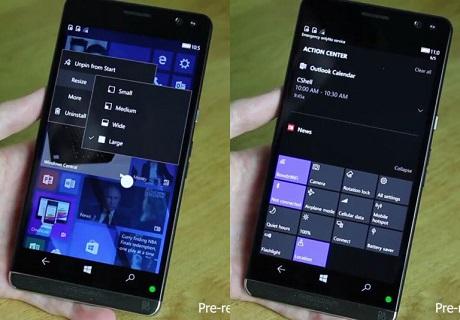
 Microsoft is reportedly working on a modular platform codenamed Windows Core OS. Last month, a Microsoft job posting revealed additional details of Microsoft’s modular OS. Today, a LinkedIn profile has surfaced online, giving us a peek at what Windows Core OS might be about. Today, we have come across an alleged LinkedIn profile of a Microsoft software engineer who was working on the Windows Core OS (WCOS) project. The profile page has revealed that Windows Core OS is not only a modular platform but also a security-focused operating system. The LinkedIn profile hasn’t revealed the release date or any other interesting details of the Windows Core OS but it looks like Microsoft is planning to enable the next generation security features in WCOS at the OS image level. “Our project was one of the first Windows Core (WCOS) based projects to migrate to the new image build system tooling designed to enable the next generation security features of the operating system at the OS image level,” the profile reads. This “next generation security features” hints at many security features that could make their way to future versions of Windows — something Synaptics has confirmed during a conference. To recall, during a conference between Synaptics and AMD, the companies discussed how biometrics could secure the “next-generation” Windows operating system. While there’s no mention of WCOS anywhere in the call, it’s certainly possible that the two companies were referencing to Windows Core OS in their mention of a next-generation Windows. Find out more on OUR FORUM.  Millions of home Wi-Fi networks could be easily hacked, even when the network is protected by a strong password, thanks to a flaw in Chrome-based browsers. Researchers at cybersecurity and penetration testing consultancy SureCloud have uncovered a weakness in the way Google Chrome and Opera browsers, among others, handle saved passwords and how those saved passwords are used to interact with home Wi-Fi routers over unencrypted connections. By design, Chrome-based browsers offer to save Wi-Fi router administration page credentials and re-enter them automatically for users' convenience. As most home routers do not use encrypted communications for management tasks, the researchers were able to exploit this automatic credential re-entering to both steal the router login credentials and use them to capture the Wi-Fi network password (PSK) with only a single click required by the user for the attack to succeed. The weakness applies to any browser based on the Chromium open source project, such as Google Chrome, Opera, Slimjet, Torch, and others. Any router that has an administration portal delivered over cleartext HTTP by default (or enabled) would be affected by this issue, which makes router and device updates impractical. The issue was responsibly disclosed to Google's Chromium project (which develops the code for Chrome and other browsers) on March 2nd, 2018. Chromium responded the same day, saying that the browser feature was ‘working as designed’ and it does not plan to update the feature. More details are posted on OUR FORUM.  A security researcher has found a method that can be used to easily identify the public IP addresses of misconfigured dark web servers. While some feel that this researcher is attacking Tor or other similar networks, in reality, he is exposing the pitfalls of not knowing how to properly configure a hidden service. One of the main purposes of setting up a dark website on Tor is to make it difficult to identify the owner of the site. In order to properly anonymize a dark website, though, the administrator must configure the web server properly so that it is only listening on localhost (127.0.0.1) and not on an IP address that is publicly exposed to the Internet. Yonathan Klijnsma, a threat researcher lead for RiskIQ, has discovered that there are many Tor sites that utilize SSL certificates and also misconfigure a hidden service so that it is accessible via the Internet. As RiskIQ crawls the web and associates any SSL certificate it discovers to it's hosted IP address, it was easy for Klijnsma to map a misconfigured hidden Tor service with its corresponding public IP address. "The way these guys are messing up is that they have their local Apache or Nginx server listening on any (* or 0.0.0.0) IP address, which means Tor connections will work obviously, but also external connections will as well," Klijnsma told BleepingComputer. "This is especially true if they don't use a firewall. These servers should be configured to only listen on 127.0.0.1." When asked how often he sees misconfigured servers that expose their public IP address, he told us that it is quite common. "Continuously. I'm not even kidding. Some don't listen on http/http, so I don't know what they are, but they have onion addresses and live on both clear and dark web. Get better informed by visiting and joining OUR FORUM. |
Latest Articles
|