 An exploit for a vulnerability in Tor Browser was delivered today in a tweet that left sufficient room for comments. A security vulnerabilities broker disclosed the details because it no longer served its purpose. The exploit was part of Zerodium's portfolio and worked for Tor Browser 7.x. It existed in the NoScript component, which is a browser add-on that stops web pages from executing JavaScript, Flash, Java or Silverlight. An exploit that one can only assume Zerodium paid good money for, is just a matter of setting the Content-Type of the attacker's HTML/JS page, or a hidden service in the Tor network, to "text/html/json," to suppress any reaction from NoScript and permit all JavaScript code through. The bug worked when the user configured NoScript to block out all JavaScript by selecting the add-on's "Safest" security level. The recently released Tor Browser 8 is based on the new Firefox Quantum engine and did not inherit the flaw; neither is the latest NoScript version, which was re-written as a web extension. Zerodium burning this exploit was also prompted by the fact that Tor Browser, like all modern browsers, comes with an auto-update mechanism, which is enabled by default. This makes sure that users are not affected in any way by exploits that have already been addressed. One can disable this feature from the 'app.update' parameter in the 'about:config' menu. While some users prefer to deploy updates manually for sensitive software such as Tor Browser, the mechanism proves beneficial in such instances. There's more on OUR FORUM.  Apple removed today a very popular anti-malware app called Adware Doctor from the Mac App Store because it was gathering browsing history and other sensitive information without a user's permission and then uploading it to someone in China. Adware Doctor is promoted as an anti-malware and adware protection program that claims to be able to protect your Mac from malicious files and browser from adware. This program was the #1 paid utility in the Mac App Store with a 4.8-star rating and over 7,000 reviews. While it may have had the ability to remove infections on your Mac, it was also discovered to be quietly uploading a user's personal data without their permission to a remote site. This behavior was first discovered by a security researcher named Privacy 1st who noticed that Adware Doctor would gather a user's browsing history from the Chrome, Safari, and the Firefox browsers, a list of running processes, and App Store search history. This information is then stored in a password protected zip file called history.zip. After the history zip was created, it would be uploaded to a remote server. In a blog post released today, Patrick corroborates Private_1st's findings and provides a detailed analysis of how the program would secretly gather a user's browsing habits and application details and then upload it to a remote host. When Adware Doctor uploaded a user's data, it would send the history.zip file to a remote host named adscan.yelabapp.com. While this domain is hosted on Amazon AWS servers, its DNS records clearly show that it is administered by someone from China. Continue reading on OUR FORUM. 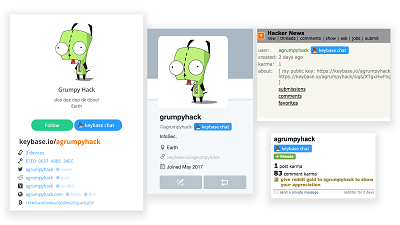 The browser extension for the Keybase app fails to keep the end-to-end encryption promise from its desktop variant. Keybase is a communication and collaboration application focused primarily on securing the traffic from source to destination through public-key cryptography. Wladimir Palant, the maker of popular AdBlock Plus content filtering tool, looked at how the web extension for Keybase works and noticed that the messages it sends are exposed to third-party JavaScript code. The extension adds a "Keybase Chat" button into profiles pages for Facebook, Twitter, GitHub, Reddit, and Hacker News. Clicking on the button opens a chat window where users can type their message. "When you compose your text and 'send' it, the extension passes it to your local copy of Keybase, which encrypts the message and sends it through Keybase chat," informs the FAQ section for the Keybase Chrome and Firefox extension. And herein lies the issue signaled by Palant: messages are not encrypted until they reach the desktop app; Keybase injects its button into web pages, but it does not isolate itself from them. "So the first consequence is: the Keybase message you enter on Facebook is by no means private. Facebook’s JavaScript code can read it out as you type it in, so much for end-to-end encryption," Palant explains. Check it out at OUR FORUM. |
Latest Articles
|