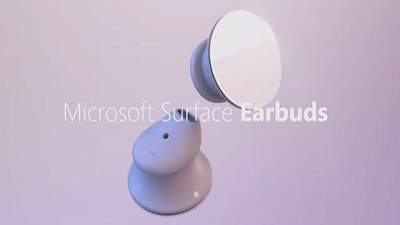
 Unlike last year’s Surface Headphones, which only worked with Cortana, the Surface Earbuds that Microsoft announced today work with any virtual assistant. That means you can use the Surface Earbuds with Cortana, but also with Alexa, Bixby, Google Assistant, Siri, or any other competitor. We talked to Surface Earbuds product lead Mohammed Samji to find out more about the $249 buds and the Surface Audio app. Like the Surface Headphones, the Surface Earbuds don’t do anything until you pair them. Surface Earbuds communicate over Bluetooth 5.0 with an Android, iOS, or Windows 10 device. Once paired, you can tap and hold either of the buds to trigger the default assistant on your device. To use a different virtual assistant with the Surface Earbuds, just change the default assistant on the paired device. “Out of the box, it just works,” Samji said. “On PC, it launches Cortana. On iOS, it will launch Siri, unless you’ve changed it. And I think it might vary depending on the distribution of Android, but all the ones I’ve tested, the first time I do it, Android asks me what I want as my default.” Surface Earbuds still offer a better experience with Cortana (although without the “Hey Cortana” wakeword), Samji made sure to emphasize. Surface Earbuds can do everything with Cortana that the Surface Headphones can do, like chit-chat, interact with your email, check your calendar, get your daily update, and create to-dos. Samji said his team created a more streamlined flow for all this Cortana functionality. It’s called Surface Audio. A Surface Audiotrademark filing from September 27 was discovered by LetsGoDigital earlier today. The trademark is classified under Class 9, which is reserved for firmware and software. Samji confirmed Surface Audio is the companion app for the Surface Earbuds. We have more posted on OUR FORUM.  Stories about China and the VPN market usually focus on the use of these virtual private networks to access news sites and social media when caught behind the country’s infamous “Great Firewall.” But now there’s a twist, with new research finding that “the top 10 Google Play search results for ‘VPN’ are dominated by [Chinese] apps participating in potentially fraudulent manipulation practices.” And those apps have secured more than 280 million installs between them. VPNs redirect internet traffic through remote servers, hiding user locations and IP addresses, encrypting information sent and received. And so this new research from the team at VPNPro is worrying on two counts. First, Google’s system appears to be easily gamed. There are no sophisticated tactics at work here—the researchers claim that basic ruses make all the difference. And, second, users might inadvertently install VPNs they believe to be popular and safe, when in fact if data is logged, if that data can be linked to the individual using the app, then the purpose of the VPN is undermined. In short, the team claims to have “uncovered what appears to be a large scale operation by Chinese VPN service providers to manipulate Google Play store results—leading to millions of people using potentially unsafe VPNs.” The team has concluded that the blatant manipulation of Google Play together with the “obligation” Chinese tech companies have “to hand data to the government when requested, “could indicate a much more serious issue beyond algorithm manipulation.” The VPNPro team found that “seven out of the top ten apps,” found to be manipulating the Google Play system, “are either based in Hong Kong, have Chinese directors or are located in China.” Commenting on the research, VPNPro security researcher Jan Youngren warned that “at best we’ve uncovered companies using underhand, unethical tactics to mislead consumers and make millions. At worst, there’s a much more sinister strategy at play to monitor and obtain the data of millions of people who have cause to use a VPN to stay safe and private—Often these people live in countries where it is dangerous to publicly express their views, or work in fields such as investigative journalism and human rights... an unsafe VPN can be a matter of life or death.”There's lots more posted on OUR FORUM.  Serial leaker 'momomo_us' has spotted multiple entries of AMD Radeon and Nvidia GeForce graphics cards by Gigabyte on the Eurasian Economic Commission(EEC)'s website. Among the mix of several GPU models getting certified, there are entries of the upcoming AMD's Radeon 5500 XT and Nvidia's GeForce GTX 1660/1650 Super graphics card SKUs. From the listing, it is noteworthy that the Radeon RX 5500 XT is equipped with 8GB of VRAM while the GeForce GTX 1660 and 1650 Super cards have 6GB and 4GB VRAM, respectively, just like their non-Super variants. Earlier today, Videocardz reported that they have received confirmation of an October 7th announcement for the Radeon RX 5500 XT as well the 5500M that we reported about a few days ago. They further added that the 5500 XT is powered by 22 RDNA Compute Units(CUs) or 1408 RDNA Stream processors. This means that the XT chip allegedly has the same CU count as the 5500M. However, the 5500 XT, being a desktop variant, maybe clocked much higher than its mobile counterpart. Over on the Nvidia side, it was first reported by Chinese website Mydrivers that a GeForce GTX 1660 Super variant was in the works with the same 1408 CUDA core configuration as the non-Super variant. However, the big change is that the Super card gets a beefed-up memory configuration thanks to the use of GDDR6 memory instead of GDDR5 on the non-Super 1660. This means that despite having the same core specification, the 1660 Super should be much faster in bandwidth bound scenarios. Another Chinese website ITHome reports that the GTX 1660 Super is due for launch on October 29. Videocardz speculates that the rumored 1650 Ti, also reported by Mydrivers previously, might well be the 1650 Super that has been listed at the EEC. Information on this GPU is still scarce with rumors floating around of it having anywhere between 1024 to 1280 CUDA cores. Learn more at OUR FORUM. |
Latest Articles
|