 You might have heard of the copyright law that states data ownership goes to the person who created the data. In this case, data refers to intellectual properties. But can the same definition be applied to smart devices all connected to the Internet? Data moves through many things before and after it is processed. So exactly who owns the machine-generated IoT data? Does the end-user own the IoT data collected by smart devices that you use? Or does the company that created the single board has rights over the data? Does the operating system on the single board tell you that they’ll own the data passing through that smart device (In their “Terms and Conditions”) Does the board manufacturer own it? Among others who can lay claim to data collected by smart devices are the software developers who program the smart devices. This is confusing and as yet, has no clear guidelines as to who owns IoT data. This is the person using different smart devices. Since they are smart devices, they are all connected to the Internet. End-users can access these devices using the related app on their smartphones or directly by punching keys on smart devices. Almost all of the data on a network is created by the end-user. If we applied the copyright law to all this, the end-user would be the IoT data owner. Unfortunately, copyright law does not yet consider smart devices’ data. There are no laws for the IoT devices at the time of writing this article (September 29, 2019). Entities that manufacture smart devices (single board micro-computers that can take certain actions when something happens) are also contenders for data obtained by the devices. They have created the micro-computers and hence their claim to the data. However, it is not feasible to give away one’s rights (end users) to someone else (the manufacturers) as we don’t know where the data will be stored and how will it be used. But there is not much an end-user can do if the hardware makers stake their claim to data without even asking for such permissions. This posting is somewhat detailed, for comprehensive details visit OUR FORUM. 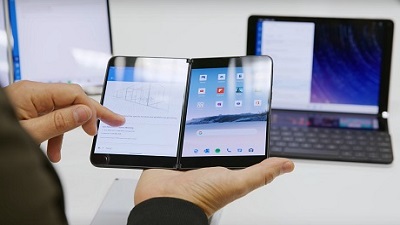 Microsoft is not done with the mobile form factor devices and the company recently announced the highly-anticipated Surface Phone called ‘Surface Duo’. Microsoft’s dual-screen device isn’t running Windows but… Android, and it will also come equipped with Google Play Store. Surface Duo will bring the best of Microsoft’s experiences, Android and excellent Surface hardware design into a single handset. Surface Duo is a 5.6-inch device with large bezels when folded and it fits inside the pocket, but Microsoft’s Panos Panay doesn’t like to call the Surface Duo a phone. In other words, Surface Duo is a dual-screen device that can do much more than any other Android phone and tablet. Duo has a hinge that joins two 5.6-inch displays and is specifically aimed at boosting productivity. Surface Duo comes with a front-facing camera and stereo sound, but the Redmond firm didn’t talk up the Surface Duo’s camera which raises an important question— will the Surface Duo have a “real” camera? The Galaxy Fold inherits cameras of the Galaxy S10 Plus and it has three lenses on the back, and two inside. The prototype of the Surface Duo, which Microsoft demoed at the Surface event, doesn’t have a rear camera, which means users will have to rely on the front-facing camera wrapped around. But it’s possible that Microsoft is internally working on a prototype of Surface Duo with an interesting camera module. Speaking at the Surface event, Panos Panay dropped hint Microsoft has other tricks to offer a decent camera in this device, but the company has no plans to reveals too many details about the camera. Follow this and more on OUR FORUM.  Microsoft has issued an out-of-band required update for all versions of Windows, rounding out the patch it released on September 23 to address an already-exploited flaw in Internet Explorer. Initially, Microsoft only released the out-of-band patch for CVE-2019-1367 on the Microsoft Update Catalog, which users needed to manually download. But Microsoft has now released it through Windows Update and Windows Server Update Services (WSUS) to distribute it more widely to end-users. "This is a required security update that expands the out-of-band update dated September 23, 2019," Microsoft warns users. The decision not to release the patch through Windows Update and WSUS caused some confusion. Why create a patch and then not distribute automatically to all Windows users until now? The IE scripting engine flaw was found by Clement Lecigne of Google's Threat Analysis Group, and Microsoft raced out the patch within days. It's likely that the vulnerability was being used to target a narrow section of Windows users. It's also not clear how much time Microsoft was able to spend regression testing its patch before releasing it. Lecigne also discovered a publicly-unknown bug in Chrome and one affecting Windows 7 in February. The flaws were being used in tandem to attack targeted users. Google released a patch for Chrome and disclosed the existence of the Windows 7 flaw before Microsoft was able to release its patch. At this stage, Lecigne has not published any details about the IE flaw. The new Windows out-of-band update also addresses a bug that caused print jobs to fail. For more turn to OUR FORUM. |
Latest Articles
|