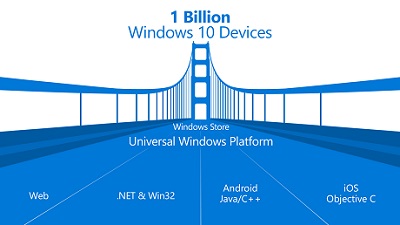
 From the launch of Windows 10, our focus was on moving people from having to choose, to loving Windows. With the release of every new build of Windows 10, we have seen customer satisfaction improve as we have made fixes and added new capabilities and experiences. We are humbled that customers are choosing and loving Windows 10, and there has never been a more important time for a secure, reliable platform that can empower people to create, educate and communicate wherever they are. Today we’re delighted to announce that over one billion people have chosen Windows 10 across 200 countries resulting in more than one billion active Windows 10 devices. We couldn’t be more grateful to our customers, partners, and employees for helping us get here. One in every seven people on the planet is planning, creating, ideating, executing, moving, shaking and doing great things with Windows 10. Because no matter who or where in the world or life they are, Windows 10 provides them with the features and flexibility they need to achieve more. From the high-powered developer who needs the most advanced technology available to the business professional who needs to be productive at work and home, to the student in a developing market who is looking for a low-cost device for learning and self-improvement—Windows 10 is the platform to meet all these needs. With 100% of the Fortune 500 now using Windows 10 devices, it has become a critical platform for driving business transformation in the enterprise and beyond. As companies transition from Windows 7 to Windows 10, they are making a commitment to running their business more efficiently, more securely, and positioning themselves to offer better products, services, and solutions to their customers. New Windows 10 features and security updates are now delivered faster than ever before. We’ve evolved from releasing a version every three years, to releasing multiple versions per year. And with the recent decoupling of the new Chromium-based Edge browser from Windows 10, we can now deliver new builds to customers outside of the normal Windows 10 release cadence—and to more versions of Windows. With Windows 10, our focus has always been to put the customer at the center, to listen to feedback, and to have that feedback shape the development process. One of the strongest examples of this customer focus is our Windows Insider Program which now has over 17.8 million Insiders, with members in every country of the world. We have also strived to make Windows an open, inclusive and accessible platform that can empower everyone to achieve their goals. Our Windows Accessibility team focuses on human-centered design, a method where engineers and designers work to deeply understand peoples’ needs, and then co-design and continuously iterate on solutions directly with them. Learn more by visiting OUR FORUM.  The Folding@home distributed computing project has added twenty new Coronavirus (COVID-19) projects since earlier this week that uses donated CPU power to research new treatment methods. Folding@home allows researchers to use donated CPU cycles to simulate protein folding to research new drug opportunities against diseases and a greater understanding of various diseases. Last week, we reported that the three new projects (11741, 11742, and 11743) that were being used to research the COVID-19 virus and how to create potential drug therapies. Since we last looked on March 9th, 2020, researchers from Memorial Sloan Kettering Cancer Center, Washington University in St. Louis, and Temple University have added 20 new projects, for a total of 23, that are all being used to analyze the proteins of Coronavirus virus. "To help tackle coronavirus, we want to understand how these viral proteins work and how we can design therapeutics to stop them," Folding@home's announcement stated.If you want to check what project you are currently working on or change some of the program's settings via a web GUI, you can select the 'Web Control' option as shown in the image above. This will open a web page showing your current work-in-progress, your settings, and the project ID you are currently contributing your CPU cycles to. To support Coronavirus projects, make sure to support research fighting 'Any Disease'. After determining the project ID number, you can look up the project ID you are working on here. For example, in the image above you can see that the project ID is 14315, which is for Cancer research. The Folding@home project has said that due to the increasing interest in the project and CPU cycles being donated, it may take some time before you receive a job to work on. "Each simulation you run is like buying a lottery ticket. The more tickets we buy, the better our chances of hitting the jackpot. Usually, your computer will never be idle, but we’ve had such an enthusiastic response to our COVID-19 work that you will see some intermittent downtime as we sprint to setup more simulations. Please be patient with us! There is a lot of valuable science to be done, and we’re getting it running as quickly as we can," Folding@home stated. If you have an idle computer sitting around doing nothing, please contribute it to the project. Who knows, the data you are assigned and solve could be what helps to create a cure! Learn more and to donate visit OUR FORUM.
 So, here we go again. Just ahead of the (now online) launch of Huawei’s next flagship, the P40, all attention turns to the impact the loss of Google will have on its sales and the workarounds available to solve the problem. Huawei hasn't given up hope of restoring Google to its new devices, and Google certainly wants the same, but until there’s a change in Trump’s blacklist, this is the path Huawei is on. We’ve been here before, of course. Last September, just ahead of the Mate 30 launch, there was lots of talk about workarounds and quick fixes. With the device in the market, talk of simple workarounds stalled and security concerns for the mainstream users won out. Sales of the device also stalled outside China. Huawei has spent the intervening months pushing its Huawei Mobile Services alternative to Google, with financial incentives for developers to jump on board. But Google is still Google, and there is no real alternative yet. As previewed for Forbes.com by David Phelan, the P40 shows every sign of being another standout hardware achievement for Huawei. But the reality is that the world outside China is not yet ready to buy a non-Google Android phone en masse. Yes, there are clunky ways around, but no, not everything will work. And there are inevitable user complexities and security concerns in trying something new. Google even took the surprise step of warning users not to try these dangerous methods. And so bear all that in mind with the latest whizz-bang workaround to hit the web. Surfacing first on Twitter and HuaweiBlog.de and picked up by Gizguide and others, there is apparently a new quick fix that makes it “even easier” to install GMS, the package of Google apps and underlying services that sits atop the basic Android OS. This is a grey area, to say the least. GMS is not licensed for new Huawei phones. So if you run this solution on a Mate 30 or P40, you are in breach of that license requirement and do not have any of the usual protections you would expect. Nor can you guarantee the software will not be switched off at some point, as happened to the well-known “LZPlay” Mate 30 workaround last year. HuaweiBlog.de says that “despite our extensive tests, app appraisal and observation of possible illegal account activity in the days after the installation, we received a legitimate security notice.” The blog does acknowledge that “we have not been able to test whether this will lead to restrictions in subsequent use.” This is notable because it seems so easy. How the app is circumventing Google security is unknown. There were implications last year that Huawei might overlook certain bypasses—their consumer head Richard Yu essentially promised users a fix—but this was all quickly shut down by Google and then Huawei. Follow this thread on OUR FORUM.
|
Latest Articles
|