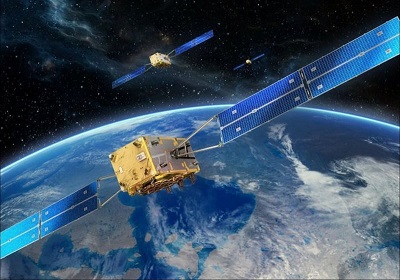
 FIBER OPTIC CABLES are the gold standard of a good internet connection, but laying them can be expensive, and in some parts of the world, a physically daunting task. So in remote corners of the globe, people often connect to the internet instead of via massive geostationary satellites. These school bus-size instruments are especially far away, producing significantly slower connections. A host of companies believe the better way to connect the estimated half of Earth’s population that’s still offline is to launch “constellations” of smaller satellites into low Earth orbit, around 100 to 1,250 miles above our planet. According to emails obtained from the Federal Communications Commission in response to a Freedom of Information Act request filed by WIRED, and confirmation from the company itself, Facebook is officially one of them. The emails show that the social network wants to launch Athena, its very own internet satellite, in early 2019. The new device is designed to “efficiently provide broadband access to unserved and underserved areas throughout the world,” according to an application the social network appears to have filed with the FCC under the name PointView Tech LLC. With the filing, Facebook joins Elon Musk’s SpaceX and Softbank-backed OneWeb, two well-funded organizations working on similar projects. In fact, SpaceX launched the first two of what it hopes will be thousands of its Starlink satellites just this past February. More in-depth detail is posted on OUR FORUM.  Security researchers have discovered a precursor of the notorious Proton macOS malware. This supposed precursor appears to have been developed back in 2016, a year before Proton and uploaded on VirusTotal, where it remained undetected for nearly two years until May 2018, when Kaspersky researchers stumbled upon it. Researchers who analyzed the malware used the term "raw" to describe its code and capabilities. It was clear in their analysis that the malware was still under development and did not have the same capabilities as the Proton remote access trojan. Proton became a household name in the infosec community in March 2017 when threat intelligence analysts from Sixgill found it being sold on an underground hacking forum for steep prices ranging from $1,200 to $820,000. Two months later, Proton was seen in the wild for the first time when someone hacked the website of the HandBrake app and poisoned the official app with the malware. Proton was used again in October 2017 when hackers breached the website of the Eltima Player and injected the malware in that app as well. More details can be found on OUR FORUM.  With Gmail’s new design rolled out to more and more users, many have had a chance to try out its new “Confidential Mode.” While many of its features sound promising, what “Confidential Mode” provides isn’t confidentiality. At best, the new mode might create expectations that it fails to meet around security and privacy in Gmail. We fear that Confidential Mode will make it less likely for users to find and use other, more secure communication alternatives. And at worst, Confidential Mode will push users further into Google’s own walled garden while giving them what we believe are misleading assurances of privacy and security. With its new Confidential Mode, Google purports to allow you to restrict how the emails you send can be viewed and shared: the recipient of your Confidential Mode email will not be able to forward or print it. You can also set an “expiration date” at which time the email will be deleted from your recipient’s inbox, and even require a text message code as an added layer of security before the email can be viewed. Unfortunately, each of these “security” features comes with serious security problems for users. Read this article and more on our Forum |
Latest Articles
|