 As reported by Cisco in its Data Privacy Benchmark Study, companies that follow the requirements of the General Data Protection Regulation (GDPR) experience benefits such as lower frequency and effect of data breaches, as well as fewer records being impacted in the attacks, shorter downtimes and lower overall costs. GDPR is a user and data privacy regulation which came into effect in the European Union on May 25, addressing data protection of EU residents and the export of personal data outside the EU and EEA areas. The report used the data collected via a double-blind survey which was answered by over 3200 security professionals from 18 countries from all over the world and from all major industries. "Organizations have a long way to go to maximize the value of their private investments. Our research shows that the market is set and ready for those willing to invest in data assets and privacy may be the path forward to get there," according to Michelle Dennedy, Cisco's Chief Privacy Officer. When it comes to the level of GDPR readiness among the respondents, 59% of them said that they are meeting either all or most of GDPR’s provisions, while 29% of them stated that GDPR-readiness is one year away and another 9% indicated that they would need more than a year to be ready. Learn more by visiting OUR FORUM. 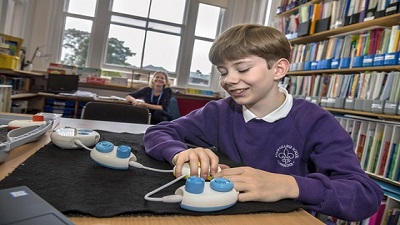 The abstract world of coding is ideal for people who are blind or have low vision, but to there is a high barrier to entry to getting started, with students first needing to learn to touch type for example. Today at BETT education show, Microsoft announced Code Jumper, a tethered hardware device designed to teach children who are blind or have otherwise impaired vision how to code. Instead of poking at tablet screens or typing into laptops, students are taking out brightly colored plastic pods, connecting them together with thick white wires and then adjusting the pod’s buttons and knobs. These physical components will be used to create computer programs that can tell stories, make music and even crack jokes. “There really isn’t an equivalent to this physical way of programming,” said Jonathan Fogg, head of computing and IT at New College Worcester. The early access to basic coding skills is important, Fogg said, because many kids who are blind or low vision are drawn to careers in computer science. He thinks that’s partly because many of the skills kids with low vision develop to navigate the world make them good at the kind of computational thinking that’s helpful for a computer science career. And, he said, traditionally it has been a career that is more accessible to people who are blind or have low vision, because of tools such as screen readers. There's more posted on OUR Forum.  On 25 and 28 May 2018, the National Data Protection Commission (CNIL) received group complaints from the association's None Of Your Business (“NOYB”) and La Quadrature du Net (“LQDN”). LQDN was mandated by 10 000 people to refer the matter to the CNIL. In the two complaints, the associations reproach GOOGLE for not having a valid legal basis to process the personal data of the users of its services, particularly for ads personalization purposes. The CNIL immediately started investigating the complaints. On 1st June 2018, in accordance with the provisions on European cooperation as defined in the General Data Protection Regulation (“GDPR”), the CNIL sent these two complaints to its European counterparts to assess if it was competent to deal with them. Indeed, the GDPR establishes a “one-stop-shop mechanism” which provides that an organization set up in the European Union shall have only one interlocutor, which is the Data Protection Authority (“DPA”) of the country where its “main establishment” is located. This authority serves as “lead authority”. It must, therefore, coordinate the cooperation between the other Data Protection Authorities before taking any decision about a cross-border processing carried out by the company. In this case, the discussions with the other authorities, in particular with the Irish DPA, where GOOGLE’s European headquarters are situated, did not allow to consider that GOOGLE had a main establishment in the European Union. More details can be found on OUR FORUM. |
Latest Articles
|