 The rollout of GDPR (General Data Protection Regulation) has changed the face of privacy and data protection for millions of people across Europe. The regulation not only grants people access to the personal data companies hold about them but also controls how this data can be used and transferred. Apple's Tim Cook has already voiced his support for GDPR and said that the rest of the world should implement similar regulation. Now he has been joined by Cisco in calling for data laws to be embraced by the US as they have been in Europe. Acknowledging the increasing worldwide interest in privacy, Cisco's chief legal officer, Mark Chandler, expressed his belief that the US would benefit from its own GDPR-style laws. Speaking to the Financial Times, he said: "We believe that the GDPR has worked well and that with a few differences, that is what should be brought in in the US as well". While there have been calls from various quarters for the US to adopt some form of regulation for user data, there are concerns that Europe's GDPR is too broad. There have also been warnings that any US version of GDPR needs to take into account how US businesses work -- hence Chandler's mentioning of "a few differences". Follow this thread on OUR FORUM. 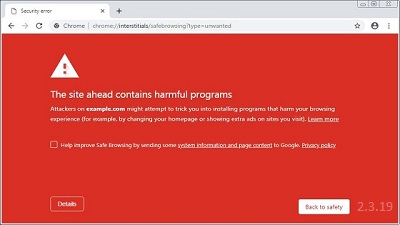 Google is adding a new feature to Google Chrome that will warn users about similar, or lookalike, URLs that a user may visit thinking they are going to the normal site. This feature is designed to warn users when they visit typosquatting domains, IDN Homograph Unicode attacks, scams, and phishing sites. In the current Canary builds of Chrome 74, a new experimental feature has been added that will alert users that they are visiting an URL that may be pretending to be or acting as a "lookalike" to a legitimate URL. For example, URLs like appl3.com, tw1tter.com, or m1crosoft.com. When users go to these URLs, Chrome will display a warning under the address bar stating "Did you mean to go to [ url ]?". For example, you can see that when we tried to go to the appl3.com URL it asks "Did you mean to go to apple.com/?". By default, this feature is only available in the Chrome Canary builds for Chrome 74. To test the lookalike feature, you can download Chrome Canary and enter chrome://flags into the address bar. At the Experiments page, search for lookalike and then change "Navigation suggestions for lookalike URLs" to Enabled. You will then be prompted to relaunch the browser as shown below. A new Chromium Gerrit post indicates that these lookalike warnings may be moved to their very own browser interstitial instead. Chrome uses interstitial pages to display warnings to users before they actually visit the requested site. Read the whole story on OUR FORUM.  Dozens of Android camera applications, some of them with over 1 million installs on the Google Play Store, were serving malicious ads and fake update prompts while also making sure that they won't be uninstalled by hiding their entries from the application list. Lorin Wu, a mobile threats analyst for Trend Micro, sorted these malicious apps in two different categories: some of them were variations of the same camera application designed to beautify photos, while the other kind allowed their users to apply photo filters on their snapshots. These apps have all been removed from the Google Play store by now, but not before they were able to amass millions of installations (some of them most probably fake). All of them were also obviously connected to each other given that they were sharing various design components such as the screenshots added to their Google Play entries. According to Wu, the beauty camera apps detected as AndroidOS_BadCamera.HRX, were "capable of accessing remote ad configuration servers that can be used for malicious purposes." After installation, they would automatically hide from the application list to make sure the victim would not be able to remove them and start displaying adult content and fraudulent content ads using the default web browser after every device unlock event. To add insult to injury, the user would not be able to pinpoint the app that pushed the ads, while some of the advertisements redirected the victims to websites which asked for personal information to be able to collect various fake prizes. Learn more from OUR FORUM. |
Latest Articles
|