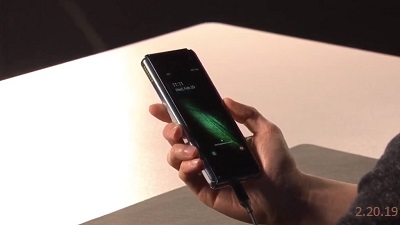
 At the Galaxy Unpacked event, the South Korean smartphone maker Samsung announced the highly anticipated foldable phone, the Galaxy Fold. Samsung Galaxy Fold packs a large 7.3-inch Infinity Flex Display that allows the device to switch between the tablet and phone mode. At the event, Samsung showed off the Galaxy Fold switching flawlessly between phone and tablet mode. The foldable device can run three apps at once and Samsung’s app continuity system will adjust these apps when you unfold or fold the device. Samsung has worked with Google and the community developers to optimize the apps for its foldable phone. At the event, Samsung revealed that its Galaxy Fold device is configured to work with all popular apps and even the Microsoft Office suite. The software and hardware have been optimized to work with apps like Google Maps WhatsApp, as well as the Microsoft Office productivity suite. Microsoft Office apps have been specially adapted to work with the 7.3-inch display and it will be able to adjust the interface quickly when you move between the two form factors. Samsung’s first foldable is simply called the Galaxy Fold. It has a 7.3-inch Infinity Flex screen when opened and it switches to a 4.6-inch screen when it’s folded. The resolution of the giant display is 1536 x 2152 and it reduces to 840 x 1960 when it’s folded. Samsung Galaxy Fold uses two batteries and while they are separated by the fold, they are combined when you boot the operating system. Full details can be found on OUR FORUM.  Microsoft will begin rolling out SHA-2 standalone updates for Windows 7 and Windows Server 2008 in March in preparation for its July 16 implementation deadline. Windows 7 and Windows Server 2008 users need to have SHA-2 code-signing installed by July 16, 2019, in order to continue to get Windows updates after that date. Microsoft issued that warning on February 15 via a Support article. Windows operating system updates are dual-signed using both the SHA-1 and SHA-2 hash algorithms to prove authenticity. A bug going forward, due to "weaknesses" in SHA-1, Microsoft officials have said previously that Windows updates will be using the more secure SHA-2 algorithm exclusively. Customers running Windows 7 SP1, Windows Server 2008 R2 SP1 and Windows Server 2008 SP2 must have SHA-2 code-signing support installed by July 2019, Microsoft officials have said. Microsoft has published a timeline for migrating these operating systems to SHA-2, with support for the algorithm coming in standalone updates. On March 12, Microsoft is planning a standalone update with SHA-2 code sign support for Windows 7 SP1 and Windows Server 2008 R2 SP1. It also will deliver to WSUS 3.0 SP2 the required support for delivering SHA-2 updates. Microsoft will make available a standalone update with SHA-2 code sign support for Windows Server 2008 SP2 on April 9, 2019. Learn more by visiting OUR FORUM.  Facebook deliberately broke privacy and competition law and should urgently be subject to statutory regulation, according to a devastating parliamentary report denouncing the company and its executives as “digital gangsters”. The final report of the Digital, Culture, Media and Sport select committee’s 18-month investigation into disinformation and fake news accused Facebook of purposefully obstructing its inquiry and failing to tackle attempts by Russia to manipulate elections. “Democracy is at risk from the malicious and relentless targeting of citizens with disinformation and personalized ‘dark adverts’ from unidentifiable sources, delivered through the major social media platforms we use every day,” warned the committee’s chairman, Damian Collins. Labour moved quickly to endorse the committee’s findings, with the party’s deputy leader, Tom Watson, announcing: “Labour agrees with the committee’s ultimate conclusion – the era of self-regulation for tech companies must end immediately. “We need new independent regulation with tough powers and sanctions regime to curb the worst excesses of surveillance capitalism and the forces trying to use technology to subvert our democracy.” The culture secretary, Jeremy Wright, who is to meet Zuckerberg this week to discuss harms resulting from social media, will likely come under pressure to raise the committee’s concerns with the Facebook chief executive directly. Launched in 2017 as concern grew about the influence of false information and its ability to spread unscrutinized on social media, the inquiry was turbocharged in March the following year, with the Cambridge Analytica data-harvesting scandal. There's more posted on OUR FORUM. |
Latest Articles
|