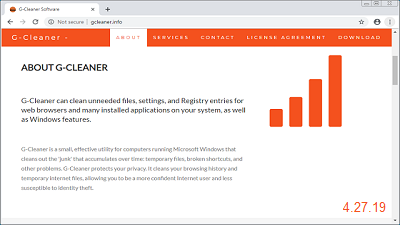
 Researchers have discovered a web site pushing a PC cleaner tool for Windows that in reality is just a front for the Azorult password and information-stealing Trojan. AZORult is a trojan that when installed attempts to steal a user's browser passwords, FTP client passwords, cryptocurrency wallets, desktop files, and much more. Instead of renting distribution methods such as spam, exploit kits, or being dropped by other trojans, the attackers decided to create a fake Windows utility and an accompanying web site to distribute the Trojan instead. According to the site, G-Cleaner or Garbage Cleaner is a Windows junk cleaner that removes temporary files, broken shortcuts, and unnecessary Registry entries. Overall, it's promoted like all the other system optimization tools that we see regularly being offered. Even when you download and run the program, it looks like countless other homemade PC cleaners and states it will scan your computer for junk files and remove them. When the G-Cleaner program is installed, it will download the main components of the fake PC cleaner and save them to the C:\ProgramData\Garbage Cleaner or C:\ProgramData\G-Cleaner folders depending on the version. It will then extract a randomly named file to the %Temp% folder and execute it. This file is the malware component that will attempt to steal your computer's passwords, data, wallets, and other information. Even though this site and the malware that is being pushed is over one month old, the site is still up and running. Just yesterday, another researcher named JamesWT discovered it again and even a month later, few antivirus vendors were detecting it as malicious. Further details can be found on OUR FORUM.  If you using a Roaming User Profile and customize your Windows 10 Start Menu, any changes will be reset after upgrading to a newer version of Windows 10. Windows creates a profile for every user, which contains the changes made by the logged in user to the Windows configuration or application settings. These user profiles are normally stored on the local computer, but domain admins can configure users so that their profiles are instead stored on a network share as a Roaming User Profile. This allows users to configure the appearance of Windows or make changes to a program's configuration and have those same settings available on any other computer they log into on the same domain. In a support article, Microsoft has stated that users using a Roaming User Profile and who customize the appearance of the Start Menu will have those changes reset after upgrading to a new version of Windows 10. According to Microsoft, you can fix this issue by installing the latest cumulative update for Windows and performing the following a few easy steps. Microsoft notes that this fix will only work if the Start Menu customizations that are stored locally and have not been deleted due to a group policy configured by an administrator. "This will only work if a user’s profile with start menu customization is available locally. If the profile was deleted due to a group policy, creating a new roaming profile will not help." We have the workaround posted on OUR FORUM.  There is a growing disparity in the US between the demand for STEM-related employment and the education and training students receive in preparation for those jobs. According to the iDTech’s report of 2018 STEM statistics, only 36% of high school graduates are ready for college-level science and “US universities are expected to produce only 29% of the required number of grads” to fill the 1.4 million computer specialist job openings reported by the Department of Labor. Based on most statistics, the issue in a lack of a prominent STEM-educated workforce is the shortcoming of nurturing early interest to which young girls and women becoming rounding errors when all is said and done. Despite 74% of middle school girls expressing some level of interest in math, science, and engineering only 0.3% decided to make a go at in college and of the ones who do seek STEM-related fields in college, they make up 18% of the total computer science undergrad population. The matters are further compounded when breaking down racial segmentation, where the National Science Foundation reported that while math and science scores for 8th graders were increasing ‘modestly’ overtime across the board, “by 2013, the average score of blacks was just above the basic level, whereas whites and Asians/Pacific Islanders had scores near and above the proficient level, respectively.” In an attempt to address the issue of generating and nurturing interest in one of the most underserved communities in young African American women, Microsoft and Black Girls CODE have teamed up to open up a Seattle Chapter of the Oakland based community project dedicated to educating girls of color between the ages of 7 and 17 about computer programming and technology. Learn more by visiting OUR FORUM. |
Latest Articles
|