 Google is looking at more options to boost its bottom line, and one of them seems to be shopping links tucked under YouTube videos. The company is running a test where it displays recommended products along with prices on its video-sharing platform, according to The Information. It seems some test ads have popped up under Nike videos. Clicking on them would take you to the Google Express marketplace to complete the purchase. More and more retailers are joining Express, according to the report, while earlier this year Google started testing shoppable ads in image searches. The company is said to be banking on these features to boost its shopping business. Parent company Alphabet reported this week that revenue for physical products such as Pixel phones and Home smart speakers year-over-year, highlighting that there's an opportunity for growth. Meanwhile, Amazon's ad business is growing, which might be prompting Google to focus on other revenue streams since ads are a key source of its income. Google takes a cut from goods sold through Express, though revenue pales next to Amazon's retail income. Express is said to have pulled in a little under $1 billion is 2018, while Amazon's retail arm generated around $141 billion in North America last year. Google is set to hold an event later this month called Google Marketing Live (at which it has revealed ad products in the past), while the I/O developer conference takes place next week, so we might have an official word about the YouTube product ads soon. There's more posted on OUR FORUM.  A new ransomware has been discovered called MegaCortex that is targeting corporate networks and the workstations on them. Once a network is penetrated, the attackers infect the entire network by distributing the ransomware using Windows domain controllers. In a new report, Sophos has stated that they have seen customers in the United States, Italy, Canada, France, the Netherlands, and Ireland being infected with this new ransomware. As this is a fairly new ransomware, not much is currently known about its encryption algorithms, exactly how attackers are gaining access to a network, and whether ransom payments are being honored. As Sophos has found that the Emotet or Qakbot Trojans have been present on networks that have also been infected with MegaCortex, it may suggest that the attackers are paying Trojan operators for access to infected systems in a similar manner as Ryuk. While it is not 100% clear how bad actors are gaining access to a network, victims have reported to Sophos that the attacks originate from a compromised domain controller. On the domain controller, Cobolt Strike is being dropped and executed to create a reverse shell back to an attacker's host. Using this shell, the attackers remotely gain access to the domain controller and configure it to distribute a copy of PsExec, the main malware executable, and a batch file to all of the computers on the network. It then executes the batch file remotely via PsExec. When encrypting a computer, the ransomware will append an extension, which in one case is .aes128ctr, to encrypted file's names. For more detailed information visit OUR FORUM. 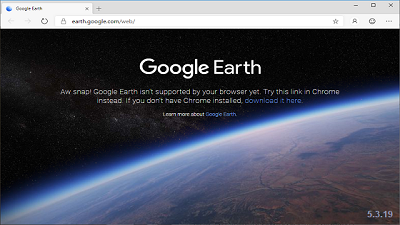 Chromium-based Microsoft Edge users who try to use Google Earth are welcomed by an error message and a link directing them to download Google's Chrome web browser. This might be a surprise for some given that the new Edge uses the same HTML engine as Chrome and that, after 12 years of being a cross-platform desktop application, Google Earth has been converted into a web app which should allow users to "explore worldwide satellite imagery and 3D buildings and terrain for hundreds of cities," according to its website. At the moment though, when users try to launch the Google Earth web app in Microsoft's new Chromium Edge, they get the following error: "Aw snap! Google Earth isn't supported by your browser yet. Try this link in Chrome instead. If you don't have Chrome installed, download it here. Learn more about Google Earth." As Microsoft Edge Product Manager Eric Lawrence explained in a Twitter thread following user reports the issue stems from the fact that the Chromium-based Edge browser does not ship with the Portable Native Client (PNaCl) component, the architecture-independent version of Native Client (NaCl) which was used by Google when converting Earth into a web app during 2017. Google updated its company-wide UA sniffer code last week to recognize Chromium-based Edge as its own browser instead of lumping it in with "Chrome." Some Google products have an explicit allow-list of supported browsers, and those products didn't all update their allow list to say "Oh, and new Edge is fine too." Get better informed by visiting OUR FORUM. |
Latest Articles
|