 Microsoft President and Chief Legal Officer Brad Smith says the way the U.S. government is treating Huawei is un-American. As far as he knows, China’s leading maker of networking equipment and mobile phones should be allowed to buy U.S. technology, including software from his company. Such actions shouldn’t be taken without a “sound basis, in fact, logic, and the rule of law,” says Smith in an interview with Bloomberg Businessweek, adding that Microsoft has asked U.S. regulators to explain themselves. “Oftentimes, what we get in response is, ‘Well, if you knew what we knew, you would agree with us,’” he says. “And our answer is, ‘Great, show us what you know so we can decide for ourselves. That’s the way this country works.’” U.S. President Donald Trump has said Huawei, run by a former Chinese army technologist, is a national security threat, and his Department of Commerce has added the company to an export blacklist scheduled to take full effect in November. Trump should know better, Smith says, citing Trump’s experience in the hotel industry. “To tell a tech company that it can sell products, but not buy an operating system or chips, is like telling a hotel company that it can open its doors, but not put beds in its hotel rooms or food in its restaurant. Either way, you put the survival of that company at risk.” Book cover of Tools and Weapons: The Promise and the Peril of the Digital Age by Brad Smith Why, yes, Huawei is a key customer for Microsoft’s Windows operating system, which comes loaded on its branded consumer laptops. Four years ago, Smith and Microsoft Chief Executive Officer Satya Nadella hosted Chinese President Xi Jinping at Microsoft for a photo op with tech leaders including Apple CEO Tim Cook and Facebook CEO Mark Zuckerberg. That probably won’t happen again. Follow along on OUR FORUM. 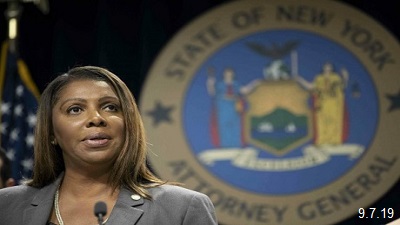 New York Attorney General Letitia James launched a multi-state antitrust investigation into Facebook on Friday, applying a new layer of pesky regulatory scrutiny to the scandal-ridden social network. The launch of the investigation comes amid greater federal and state oversight of major technology companies, including Facebook, Google, Amazon, and Apple. The state-level probe will examine a wide range of Facebook’s activities, including its handling of user data, its effects on consumer choice, and the price of advertising, New York’s attorney general said in a statement. “Even the largest social media platform in the world must follow the law and respect consumers. I am proud to be leading a bipartisan coalition of attorneys general in investigating whether Facebook has stifled competition and put users at risk,” James said. “We will use every investigative tool at our disposal to determine whether Facebook’s actions may have endangered consumer data, reduced the quality of consumers’ choices, or increased the price of advertising.” In addition to James, attorneys general from Colorado, Florida, Iowa, Nebraska, North Carolina, Ohio, Tennessee, and the District of Columbia will be on the investigation’s leadership team, according to James’ office. This probe adds to action at the federal level that began in earnest this summer. On July 23, the U.S. Department of Justice announced that it has begun an expansive investigation into “market-leading online platforms” to determine whether they “are engaging in practices that have reduced competition, stifled innovation, or otherwise harmed consumers.” We have more posted on OUR FORUM.  Web browser company Brave said on Wednesday that it learned how Google works around GDPR (the EU's data privacy regulation) to help its advertising partners identify European web users. According to the company, which offers its own privacy-focused web browser, Google uses Push Pages that contain unique identifiers to share information with its partners. Those pages appear to be made specifically for identifying web users; they have no other function. This isn't the first time Brave leveled allegations of GDPR violations against Google. The company told the UK Information Commissioner and Irish Data Protection Commission (DPC) in September 2018 that Google's advertising systems were a "massive and ongoing data breach that affects virtually every user on the web." The revelation of these Push Pages is supposed to help support those claims. Brave said the Push Pages rely on a "code of almost 2,000 characters, which Google adds at the end to uniquely identify the person that Google is sharing information about" and which can be used in conjunction with other identifiers, like browser cookies. This makes it easier for Google's partners to connect data about website visitors even if they aren't technically being given their real identity. The Push Pages don't appear to serve any other purpose. Brave said they're never visible to users, and even if someone enters their URL to visit them directly, they don't show any content. (Which implies that Google only intends for them to communicate with other background processes of which web users are probably unaware.) Visit OUR FORUM for more of Google's response to these allegations. |
Latest Articles
|