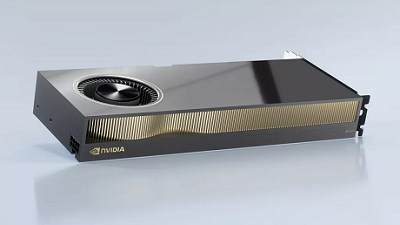
 When Nvidia launched its RTX A6000 48GB professional graphics card last October, the company said that it would offer at least twice the performance of the company's previous-gen Quadro cards. These types of claims are not unusual, but how fast is the $4,650 RTX A6000 really in real-world benchmarks? (Interestingly, that's only $650 more than Galax's flagship RTX 3090 GPU.) Workstation maker Puget Systems decided to find out and ran multiple professional-grade benchmarks on the card. Nvidia's RTX A6000 48GB graphics card is powered by its GA102 GPU with 10,752 CUDA cores, 336 tensor cores, and 84 RT cores, and a 384-bit memory bus that pairs the chip with a beefy 48GB slab of GDDR6 memory. In contrast, Nvidia's top-of-the-range GeForce RTX 3090 consumer board based on the same graphics processor features a different GPU configuration containing 10,496 CUDA cores, 328 tensor cores, 82 RT cores, and a 384-bit memory interface for its 'mere' 24GB of GDDR6X memory. While the Nvidia RTX A6000 has a slightly better GPU configuration than the GeForce RTX 3090, it uses slower memory and therefore features 768 GB/s of memory bandwidth, which is 18% lower than the consumer graphics card (936GB/s), so it will not beat the 3090 in gaming. Meanwhile, because the RTX A6000 has 48GB of DRAM on board, it will perform better in memory-hungry professional workloads. While all GeForce RTX graphics cards come with Nvidia Studio drivers that support acceleration in some professional applications, they are not designed to run all professional software suites. In contrast, professional ISV-certified drivers of the Quadro series and Nvidia RTX A6000 make them a better fit for workstations. Not all professional workloads require enormous onboard memory capacity, but GPU-accelerated rendering applications benefit greatly, especially when it comes to large scenes. Since we are talking about graphics rendering, the same programs also benefit from GPU capabilities. That said, it is not surprising that the Nvidia RTX A6000 48GB outperformed its predecessor by 46.6% ~ 92.2% in all four rendering benchmarks ran by Puget. Evidently, V-Ray 5 scales better with the increase of GPU horsepower and onboard memory capacity, whereas Redshift 3 is not that good. Still, the new RTX A6000 48GB is tangibly faster than any other professional graphics card in GPU-accelerated rendering workloads. Modern video editing and color correction applications, such as DaVinci Resolve 16.2.8 and Adobe Premiere Pro 14.8, can also accelerate some of the tasks using GPUs. In both cases, the Nvidia RTX A6000 48GB offers tangible performance advantages compared to its predecessor, but its advantages look even more serious when the board is compared to graphics cards released several years ago. Like other modern professional graphics applications, Adobe After Effects and Adobe Photoshop can take advantage of GPUs. Yet, both programs are CPU bottlenecked in many cases, which means that any decent graphics processor (and not necessarily a professional one) is usually enough for both suites. Nonetheless, the new Nvidia RTX A6000 64GB managed to show some speed gains compared to the predecessor in these two apps as well. More facts and figures along with possible pricing can be found on OUR FORUM.  Microsoft has announced that Windows 10, version 2004 has now been added to the broad deployment channel and will be available to everyone via Windows Update. "Windows 10, version 2004 is designated for broad deployment," the company says in a status update on the Windows Health dashboard. "The recommended servicing status is Semi-Annual Channel." Microsoft officially started rolling out Windows 10 2004 (aka the Windows 10 May 2020 Update) in May 2020, but for many people, it wasn't yet being offered when checking via Windows Update. When Windows Feature Updates are first released, they are released under targeted deployment in order to test the quality of the build on targeted machines in an organization. "Targeted deployment refers to the phase immediately following the release of a new Windows version when it is recommended to conduct your organization's piloting process and to begin deployments to select devices, such as those with the most modern chipsets and capabilities," Microsoft explains. After Microsoft determines that the Windows version is ready for deployment on most or all devices, they change the Windows version to have a "broad deployment" classification. This means that all devices can be updated to Windows 10, version 2004 via Windows Update, unless they're affected by compatibility holds that block the update due to hardware issues. The release of Windows 10 2004 was not as bad as the one of Windows 10 1809, which many still see as arguably the buggiest Windows 10 version ever to see the light of day. However, Windows 10 2004 still managed to get out the gates with ten know issues under investigation, many of which are now already fixed. Microsoft added the known issues to the health dashboard right after starting the new release's rollout process, together with nine compatibility holds to prevent users of affected devices from being offered the Windows 10 2004 update. After addressing issues triggering blue screens when plugging or unplugging Thunderbolt docks, boot failures caused by the Disk Cleanup maintenance utility, as well as compatibility issues with numerous systems and hardware configurations, Microsoft has finally decided that Windows 10 2004 is ready for broad release to all customers. If you are not offered the Windows 10, version 2004 update via Window Update, then you should check the Windows 10 Health Dashboard for any known hardware blocks affecting your computer. According to the Windows 10 Health Dashboard, the only known blocks for Windows 10 2004 updates are for devices with Conexant ISST audio drivers. As Home, Pro, Pro Education, Pro for Workstations editions of Windows 10 1909 are reaching the end of service on May 11, 2021, Microsoft is now allowing a limited set of customers (with devices running Windows 10 1903 and higher to upgrade to the latest released version, Windows 10, version 20H2. These customers are known as "seekers," which is short for users who are manually seeking to update to the latest Windows version by clicking "Check for updates" via Windows Update. Microsoft says that it's also "slowly throttling up availability over the coming weeks to ensure a reliable download experience." If you are running older Windows 10 versions, you are strongly advised to update to a newer version to continue receiving timely security updates.  Apple says it will roll out a new privacy control in the spring to prevent iPhone apps from secretly shadowing people. The delay in its anticipated rollout aims to placate Facebook and other digital services that depend on such data surveillance to help sell ads. Although Apple didn't provide a specific date, the general timetable disclosed Thursday means a long-awaited feature known as App Tracking Transparency will be part of an iPhone software update likely to arrive in late March or some point in April. After delaying the planned September introduction of the safeguard amid a Facebook-led outcry, Apple had previously said it would come out early this year. Apple released the latest update as part of Data Privacy Day, which CEO Tim Cook will salute during a speech scheduled Thursday at a technology conference in Europe. Apple has been holding off to give Facebook and other app makers more time to adjust to a feature that will require iPhone users to give their explicit consent to being tracked. Analysts expect a significant number of users to deny that permission once it requires their assent. Currently, iPhone users are frequently tracked by apps they install unless they take the extra step of going into iPhone settings to prevent it. Facebook stepped up its attacks on Apple’s new privacy control last month in a series of full-page ads in The New York Times, The Wall Street Journal, and other national newspapers. That campaign suggested some free digital services will be hobbled if they can’t compile personal information to customize ads. On Wednesday, CEO Mark Zuckerberg questioned Apple's motives with the changes, saying the iPhone maker “has every incentive” to use its own mobile platform to interfere with rivals to its own messaging app. “Apple may say that they are doing this to help people, but the moves clearly track their competitive interests,” Zuckerberg said. Google, which also relies on personal data to power the internet's biggest ad network, hasn't joined Facebook in its criticism of Apple's forthcoming controls on track. Google profits from being the default search engine on the iPhone, a prized position for which it pays Apple an estimated $9 billion to $12 billion annually. But Google warned in a Wednesday blog post that Apple’s new controls will have a significant impact on ad revenue generated from iPhones in its digital network. Google said a “handful” of its iPhone apps will be affected by the new requirement, but did not identify which ones. “We remain committed to preserving a vibrant and open app ecosystem where people can access a broad range of ad-supported content with confidence that their privacy and choices are respected,” wrote Christophe Combette, group product manager for Google Ads. Follow this and other developments on OUR FORUM. |
Latest Articles
|